
 Camera
 Display
 Battery
 Smartphone
 Security
 DSLR & Mirrorless
 Tv Screens
 Automotive
 Medical
 3D Camera
 Industrial Vision
 Computing
 AR / VR
 Drone & Action camera

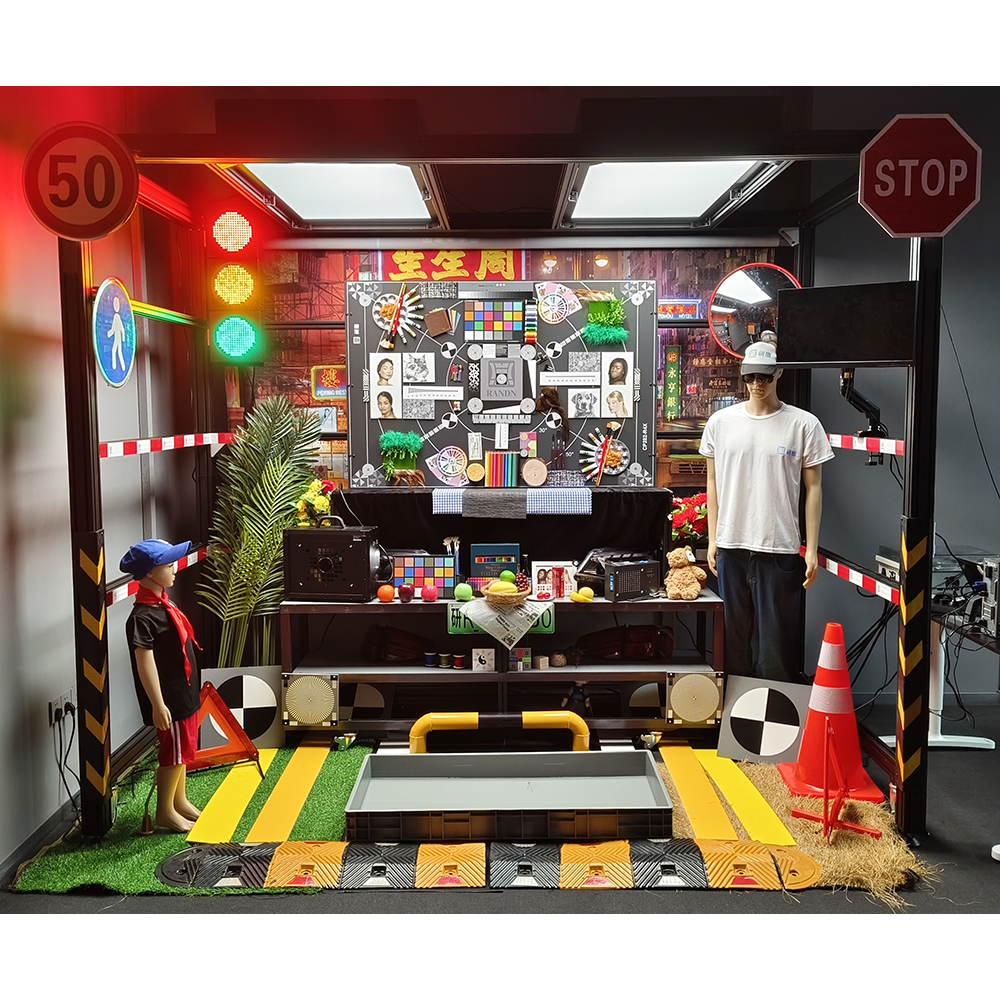
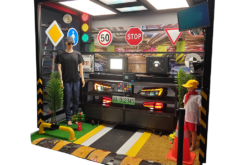
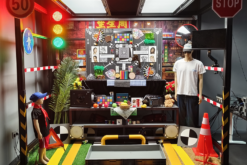
Automotive Real Scene System (ADAS Studio)
Repeatable multi-light, real-scene testing for ADAS and automotive camera validation
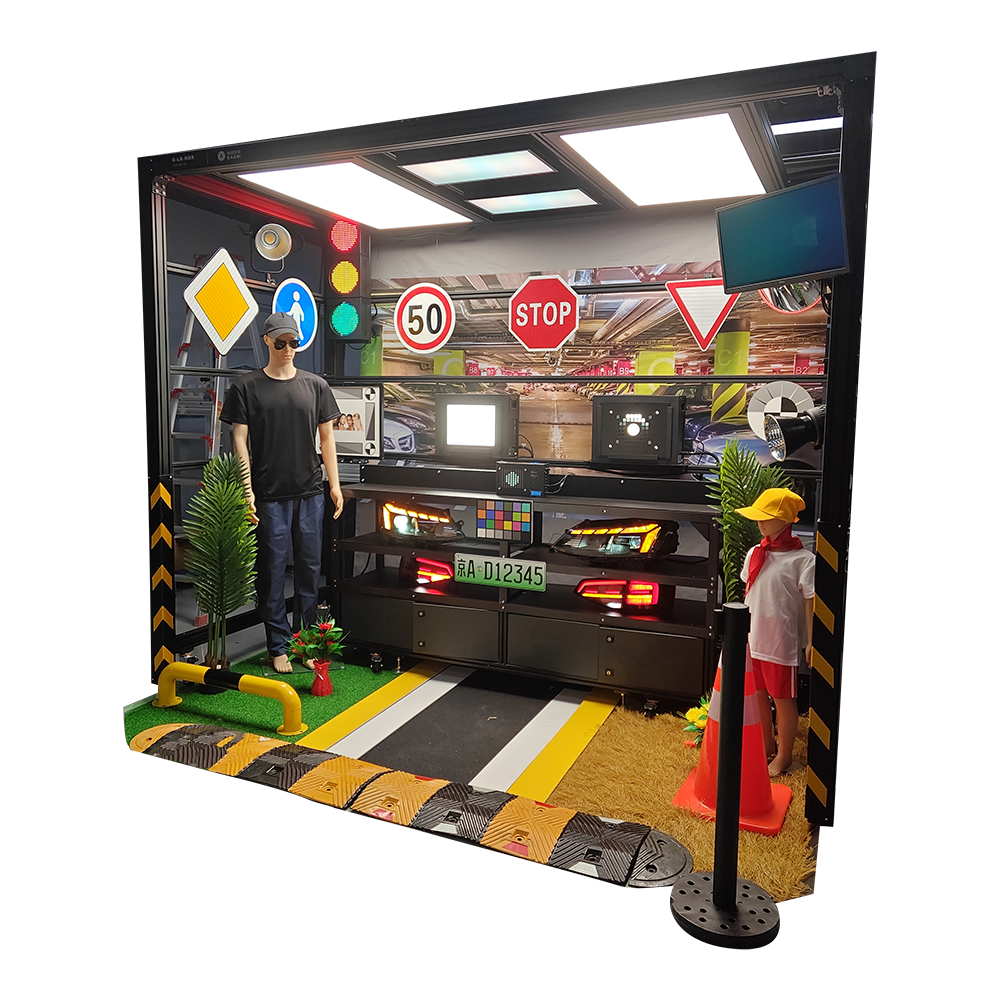
ADAS Studio is a real scene test bench built for the objective and subjective evaluation of automotive camera image quality, algorithm robustness, and perception system reliability.
Key Highlights
- Designed for automotive camera image performance evaluation
- Customization can be supported
- Integrated Multi-Light Source Design
- Flexible Control and Automation
ADAS Studio is a real scene test bench built for the objective and subjective evaluation of automotive camera image quality, algorithm robustness, and perception system reliability. As vehicle platforms move toward higher levels of driving automation, the camera stack has become a safety-critical component, and validating it requires a test environment that reproduces the complexity of a real road scene while remaining repeatable and instrumented, something neither a static lab chart nor an uncontrolled outdoor test track can offer on its own. ADAS Studio addresses this gap by combining calibrated multi-source illumination with full-scale automotive scene props on a single, repeatable bench.
Illumination architecture
The system integrates several independently controllable light sources rather than a single fixed source, because automotive image quality failures are frequently illumination-dependent rather than scene-dependent. Two overhead sources provide continuously adjustable correlated color temperature, typically spanning the range from warm tungsten-like conditions around 2700K to daylight conditions near 6500K, allowing repeatable testing of white balance, color reproduction, and auto-exposure behavior under shifting ambient light without waiting for real diurnal cycles. A multi-spectrum adjustable source extends coverage into custom spectral power distributions, which matters for validating sensors and ISPs against non-standard illuminants such as sodium vapor street lighting or LED headlight spectra. Coverage extends from visible light into the near-infrared band, relevant to cabin-monitoring cameras and sensors that retain NIR sensitivity for low-light or nighttime operation.
Two HDR transmissive light sources reproduce high-dynamic-range scene content, such as a vehicle exiting a tunnel into direct sunlight or approaching oncoming headlights at night, allowing repeatable measurement of a camera’s dynamic-range handling, highlight-clipping behavior, and local tone-mapping performance, rather than relying on inherently inconsistent field conditions. A sun simulation source reproduces a point-source glare condition consistent with direct or low-angle sun, used to characterize flare, ghosting, and veiling glare, and to verify that lens coatings and hood or sensor shielding perform as designed under a repeatable glare angle and intensity rather than a single field observation that cannot be reproduced on demand.
Real scene props and scenario coverage
Illumination alone does not validate perception performance, so the bench includes full-scale automotive scene props, including headlights, taillights, traffic signals, license plates, road signage, and human mannequins, positioned to reconstruct realistic road geometry and object scale. This allows testing of the specific recognition tasks that matter to ADAS and autonomous driving pipelines, including traffic light state recognition, vehicle light state recognition, road sign legibility, and lane marking detection, under illumination conditions set independently by the light sources described above, so a failure can be attributed to a specific lighting condition rather than treated as an unexplained field anomaly.
Motion and dynamic testing
A built-in motion navigation system and a rotating turntable add a temporal dimension to the otherwise static scene, supporting horizontally moving target testing, rotating target testing, and motion blur evaluation at controlled and repeatable target speeds, which is necessary to validate rolling shutter artifacts, exposure and frame rate tradeoffs, and tracking stability in perception algorithms rather than only single-frame image quality. Because scene composition, illumination, and target motion are all independently controllable, the bench supports both frame rate and exposure time characterization under fixed lighting and dynamic range and flare characterization under fixed motion, isolating variables that are normally coupled together in an uncontrolled outdoor test.
Automation and integration
The system is controlled over USB with an API layer and accompanying PC software, allowing test sequences, light source states, and motion profiles to be scripted rather than set manually for each condition. This supports automated regression testing across firmware or algorithm versions and structured data acquisition for objective scoring, while the same hardware configuration remains available for manual subjective evaluation sessions.
Evaluation coverage
The bench supports more than twelve subjective evaluation criteria directly relevant to ADAS and automotive vision validation: sharpness, color reproduction, traffic light recognition, flicker, lane marking visibility, high brightness backlight handling, road sign recognition, high dynamic range, frame rate, vehicle light recognition, horizontally moving target tracking, and rotating target tracking. Each of these can be exercised under a controlled and repeatable combination of illumination, scene content, and motion, which is the property that distinguishes bench-based ADAS validation from field trials: the same failure condition can be reproduced on demand for root cause analysis and for confirming a fix.
| Expertise | Camera |
|---|---|
| Industry | Automotive |
| Product Type | Chart & Equipements |
| Image Quality Metric | Color, Depth, Dynamic Range & Contrast, Flicker, Noise & Tone curves, Real life scenes, Resolution, Sharpness & Texture |