 Camera
  Display
  Battery
  Smartphone
  Security
  DSLR & Mirrorless
  Tv Screens
  Automotive
  Medical
  3D Camera
  Industrial Vision
  Computing
  AR / VR
  Drone & Action camera

Stabilization is one of the most critical and most challenging aspects of smartphone camera performance. It directly affects the sharpness, consistency, and overall usability of images and videos, yet its effectiveness can change significantly depending on how and where the camera is used. A device may perform well on a tripod but behave differently when handheld, walking, or shooting in low light, making stabilization particularly sensitive to both lighting conditions and the type of movement involved.
Because of this variability, stabilization cannot be fully characterized through a single test scenario or a simple visual comparison. A meaningful evaluation requires examining how consistently a device preserves detail across different lighting levels and movement conditions. By testing these variables systematically, it becomes possible to identify performance differences and understand how effectively stabilization maintains image quality as shooting conditions become more demanding.
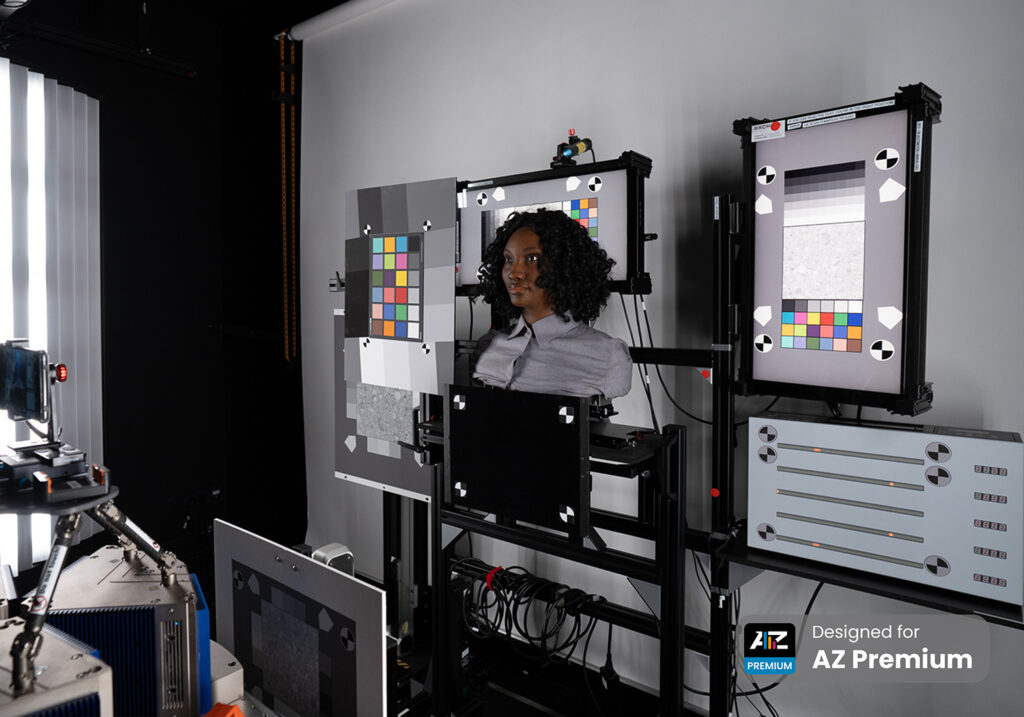
At DXOMARK, we evaluate stabilization using a realistic portrait scenario designed to closely reflect user perception. The setup combines a realistic mannequin, controlled lighting, and a shaking platform, allowing the same test conditions and movements to be reproduced across multiple devices.
Capturing stabilization performance across different conditions requires controlling several variables while reproducing realistic movement. Changes in lighting, movement, and shooting position can all affect detail preservation, making it important to maintain repeatable conditions while testing to identify variations in performance. The challenge is therefore not only to reproduce the same movements, but also to capture the differences between tripod, handheld, and walking conditions and reveal potential inconsistencies that may not be visible in individual captures.
Evaluating the OPPO Find X9 Ultra accross different conditions
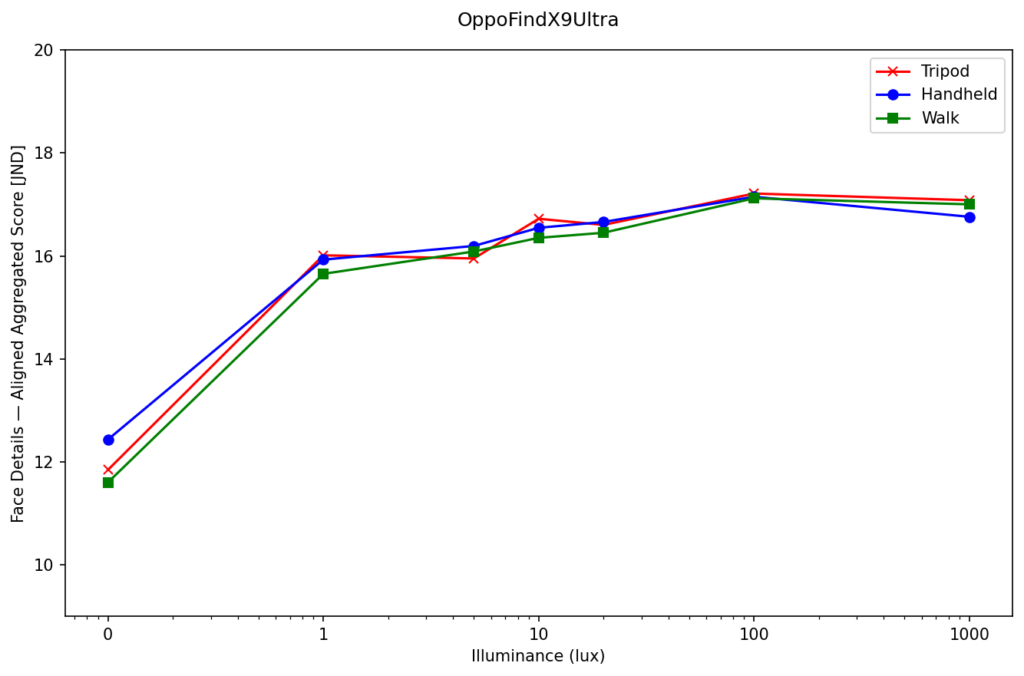
The OPPO Find X9 Ultra delivered the strongest overall stabilization performance in the benchmark, with detail preservation remaining highly stable across tripod, handheld, and walking scenarios. The variation between motion types was the smallest among the tested devices, showing that performance remained consistent as movement became more complex.
Handheld
Tripod
Walking
Data analysis
To complement the captured images, the graph below provides an objective view of the OPPO Find X9 Ultra’s stabilization performance across the tested conditions. It shows detail preservation across the full lighting range, from 0.1 to 1000 lux, for each of the three movement scenarios: tripod, handheld, and walking. This allows the results to be analyzed quantitatively, showing how detail preservation varies with both lighting and movement, rather than relying solely on a visual comparison of individual images.
Consistency in Extreme Low-Light Conditions
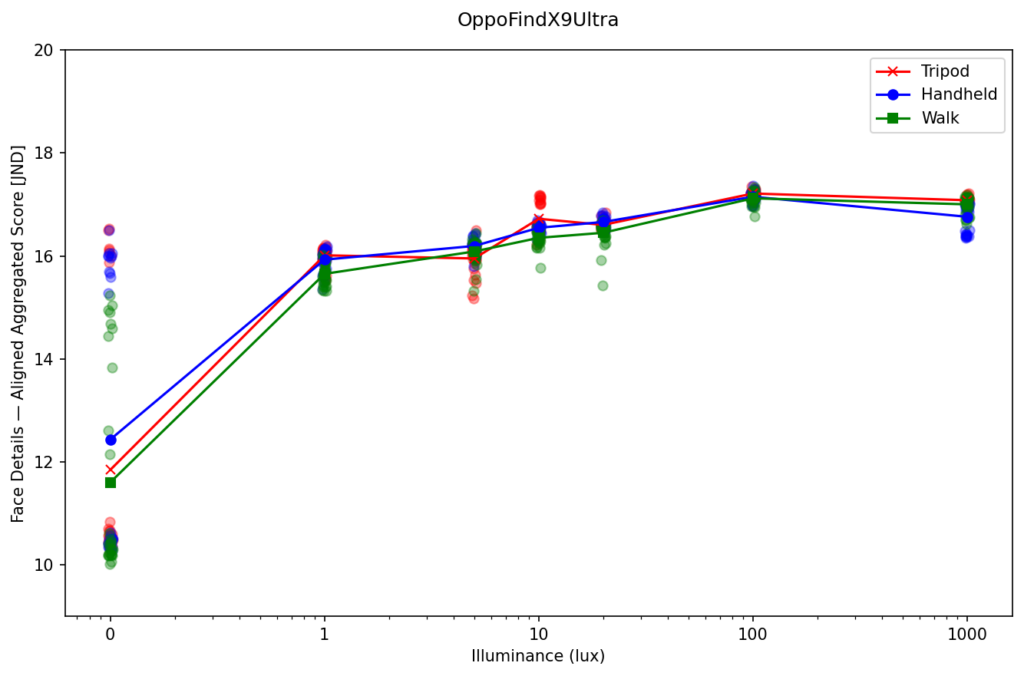
At 0.1 lux, the OPPO Find X9 Ultra results reveal two distinct clusters of captures: one showing very good detail preservation and another showing the lower quality expected under such extreme low-light conditions. While the individual images help illustrate this difference, the graph makes the variation across captures clearly visible.
Handheld
Tripod
Walking
This is where repeated captures become particularly important. Taking 30 or more photos under the same lighting condition makes it possible to identify variations that may remain hidden when looking at only a few images. In this case, the measurements reveal a gap between the best and lower-quality results, providing a clearer view of the consistency and reliability of the camera’s stabilization performance.
This example illustrates the value of exhaustive testing: rather than showing only what a camera can achieve in its best captures, repeated measurements reveal the full range of performance and help identify potential gaps in consistency.
Measuring Stabilization Beyond the Single Capture
The All-in-One Portrait Stabilization Packages provide a controlled, repeatable solution for evaluating photo stabilization performance under varying movements and lighting conditions. By combining the required test setup with controlled lighting and repeatable motion, the solution enables camera systems to be evaluated consistently across tripod, handheld, and walking scenarios, over the range of 0.1 to 1000 lux.
A key benefit of this approach is the ability to go beyond individual captures and analyze the consistency of stabilization performance. As demonstrated by the OPPO Find X9 Ultra at 0.1 lux, repeated captures can reveal variations that may not be visible from a limited number of images. Capturing 30 or more photos for each lighting condition provides a broader set of results, making it possible to identify performance gaps and better understand how consistently a camera maintains detail preservation.
By combining controlled and repeatable testing with objective measurements, the solution provides a clear view of stabilization performance across the conditions under evaluation. This enables camera teams to identify not only the level of performance achieved, but also variations and potential consistency gaps that could otherwise remain undetected.