
 Camera
  Display
  Battery
  Smartphone
  Security
  DSLR & Mirrorless
  Tv Screens
  Automotive
  Medical
  3D Camera
  Industrial Vision
  Computing
  AR / VR
  Drone & Action camera

Camera performance has become an increasingly important differentiator in the smartglasses market. Unlike smartphones, smartglasses are designed for first-person, hands-free image capture, introducing new constraints related to camera placement, shooting conditions, and computational photography.
To assess the current state of smartglasses imaging, we benchmarked the portrait and low-light performance of several commercially available devices. The objective is to provide an objective evaluation of current imaging capabilities and highlight the technical trends shaping the next generation of smartglasses cameras.
Methodology and Tested Devices
The benchmark combines controlled laboratory measurements with real-world image evaluation to assess camera performance across representative shooting conditions.
Laboratory Measurements
- 20 lighting conditions
- 2 flare configurations
- 9 stabilization configurations
Real-Scene Evaluation
- Illumination levels ranging from low light to outdoor daylight
- SDR and HDR scenes
- Portrait and landscape scenarios
- Duo portrait scenes
Devices Evaluated
Rayneo X3 Pro, Ray-Ban Meta Gen2, INMO Air 3, HTC Vive Eagle, Rokid AI Glasses, Quark AI Glasses, Ray-Ban Meta Display

Benchmark Results
Portrait Performance
Portrait photography is an important use cases for smartglasses for smartglasses, but it also illustrates the differences between wearable cameras and smartphones.
Unlike smartphones, where users can easily adjust framing and camera position, smartglasses capture images from a fixed first-person perspective. Camera placement, head movement, and the diversity of lighting conditions make it more difficult to achieve consistent portrait quality. As a result, portrait rendering depends not only on camera hardware, but increasingly on computational photography and image-processing algorithms.
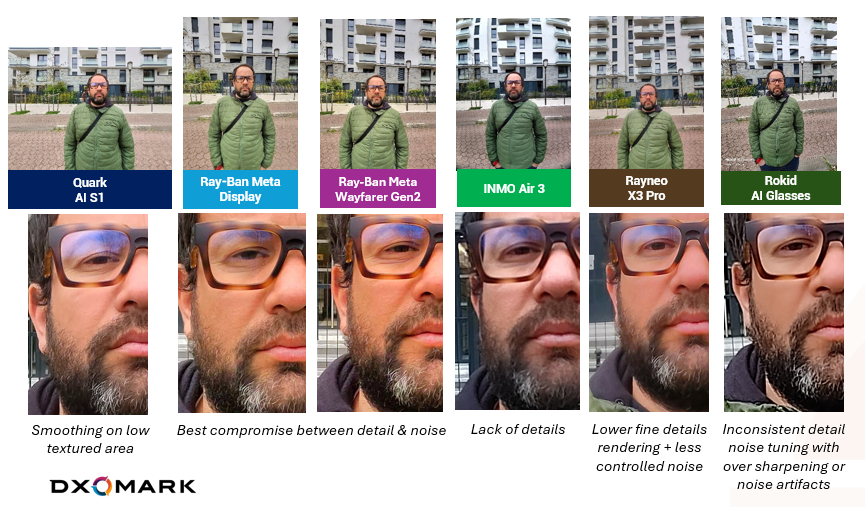
Our benchmark evaluated portrait image quality across three key attributes: exposure, color rendering, and detail preservation & noise management.
Exposure
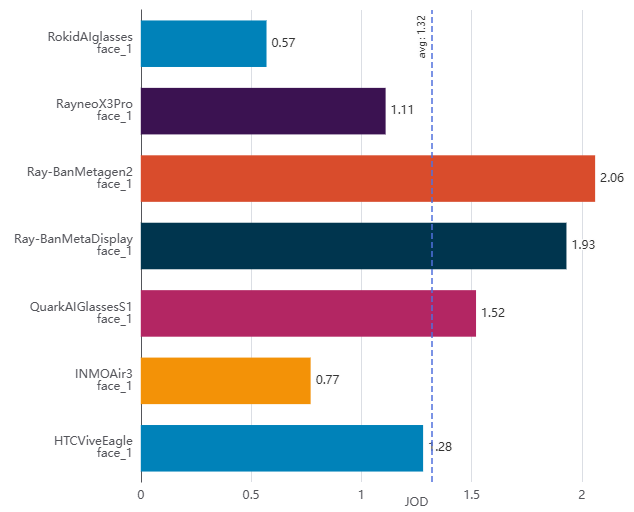
Portrait exposure remains highly dependent on lighting conditions. Most devices now achieve acceptable exposure in standard outdoor SDR environments, demonstrating that outdoor photography is reaching a first level of maturity. However, maintaining consistent facial exposure across more complex lighting conditions remains a challenge.
Color Rendering
Natural skin tone reproduction continues to be a key differentiator in portrait image quality. Even under daylight conditions, noticeable differences remain between devices, reflecting each manufacturer’s approach to color calibration and image processing.
Detail Preservation & Noise Management
Portrait rendering is increasingly shaped by computational photography rather than camera hardware alone. Manufacturers adopt different processing strategies, resulting in varying trade-offs between texture preservation and noise reduction.
As imaging hardware becomes more comparable across devices, portrait performance is increasingly determined by software tuning and image-processing pipelines. This growing convergence in hardware capability highlights the role of computational photography as a key differentiating factor across the current smartglasses ecosystem.
Low-Light Performance
Low-light imaging remains one of the most challenging scenarios for current smartglasses.
Compared with smartphones, smartglasses rely on highly compact camera modules, whose small size inherently limits light collection. In low-light conditions, this often requires longer integration times and higher sensor gain, leading to trade-offs between noise, detail preservation, and overall image quality.
These constraints reduce the amount of available light reaching the sensor and place greater reliance on computational photography to balance exposure, preserve detail, and control image noise.
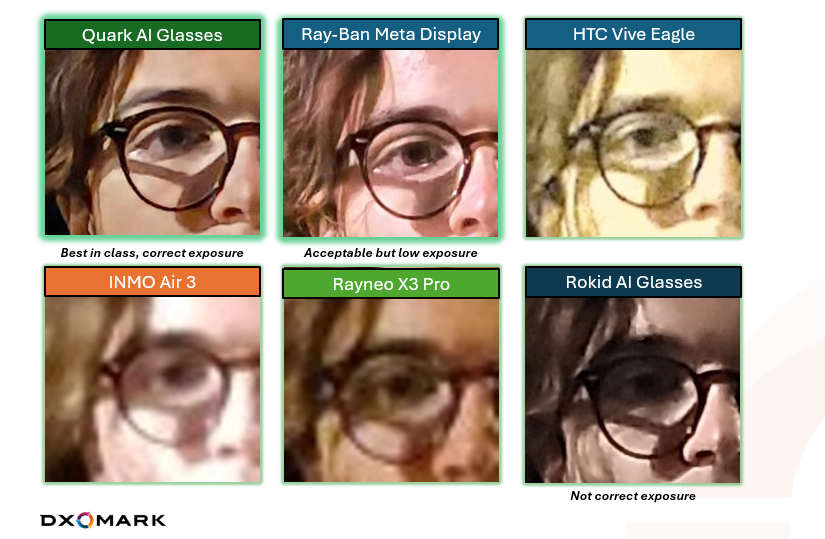
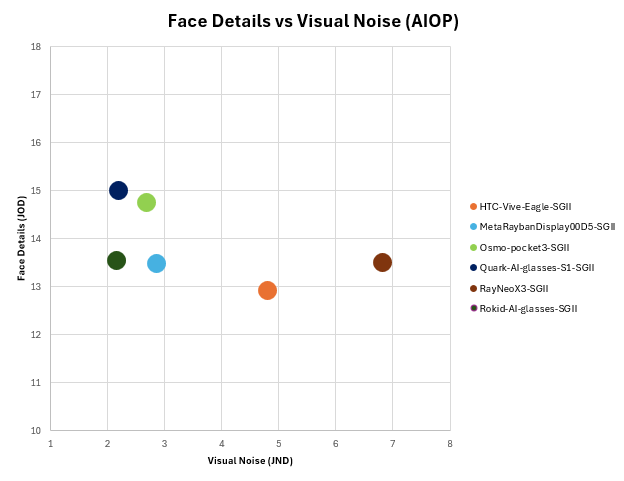
Across all devices evaluated, image quality decreases as illumination levels drop. Common observations include increased noise, reduced sharpness, lower detail retention, and less stable white balance.
Within this benchmark, the Ray-Ban Meta Display and Quark AI Glasses delivered the most consistent low-light performance, producing more balanced exposure, improved noise control, and overall more usable images across the tested scenes.
The remaining devices including Rayneo X3 Pro, INMO Air 3, HTC Vive Eagle, and Rokid AI Glasses showed more pronounced degradation under reduced illumination, with greater losses in detail and increased image noise.
Conclusion
The benchmark shows that smartglasses imaging is entering a more mature stage. In outdoor portrait photography, most devices now achieve consistent exposure and overall image quality under standard conditions, reflecting the progress made across the industry.
At the same time, portrait rendering strategies and low-light performance continue to differentiate products. HDR scenes, dynamic-range management, and low-light imaging remain the most demanding use cases, where computational photography has become the primary driver of image quality.
As the smartglasses market continues to evolve, objective benchmarking provides manufacturers with measurable insights into imaging performance, helping identify optimization opportunities and track progress across future generations of devices.
Explore the Smartglasses Benchmark in More Detail
This article presents a summary of the benchmark findings.
Complete the form below to access additional benchmark insights and watch the full webinar replay featuring Counterpoint and Qualcomm.