 Camera
  Display
  Battery
  Smartphone
  Security
  DSLR & Mirrorless
  Tv Screens
  Automotive
  Medical
  3D Camera
  Industrial Vision
  Computing
  AR / VR
  Drone & Action camera
Challenges
- Evaluating image stabilization performance in modern camera systems is more complex than simple blur reduction. Traditional standards such as the CIPA DC-011-2024 or ISO 20954-1:2019, specifications provide a baseline for comparing stabilization by measuring sharpness at increased longest exposure times, but they have limitations. These include reliance on specific charts, high-contrast edges, and metrics that do not align with modern MTF-based image quality approaches. As a result, standardized tests may not reflect realistic use conditions or fully characterize stabilization systems, especially nowadays with video.
- Engineering teams need:
- A realistic and repeatable motion reproduction system that reflects real user camera motion
- A comprehensive measurement framework supporting both still image and video stabilization
- Objective metrics that quantify motion compensation and geometric distortion
- Integration into automated lab workflows to ensure operator-independent results
Solutions
- DXOMARK’s stabilization testing solution combines high-precision motion platforms, realistic movement profiles, and advanced analysis metrics to extend stabilization tests beyond traditional standards. These capabilities are integrated with Analyzer hardware and software for a complete lab-ready workflow.
Results
- Objective, repeatable characterization of stabilization effectiveness across a wide range of motion profiles
- Standards-aware metrics that reflect both still and video stabilization performance under realistic use cases
- Integrated lab workflows with automation support via Analyzer, reducing operator variability and time costs
- Actionable insights to guide system tuning and design trade-offs, including mechanical stabilization, sensor shift algorithms, and electronic motion compensation
Realistic Motion Reproduction
At the core of the solution are hexapod motion platforms capable of simulating six-axis movements with high precision and repeatability. These platforms reproduce controlled motion profiles such as handheld shake, walking, running, and other real usage dynamics, enabling:
- Consistent camera motion across test runs
- Repeatable and comparable evaluation between different devices
- Support for complex motion axes relevant to both photo and video stabilization testing
These hexapod systems are designed to minimize unwanted mechanical artefacts and deliver precise paths across all axes, ensuring objective motion simulation.
Learn more about movement definition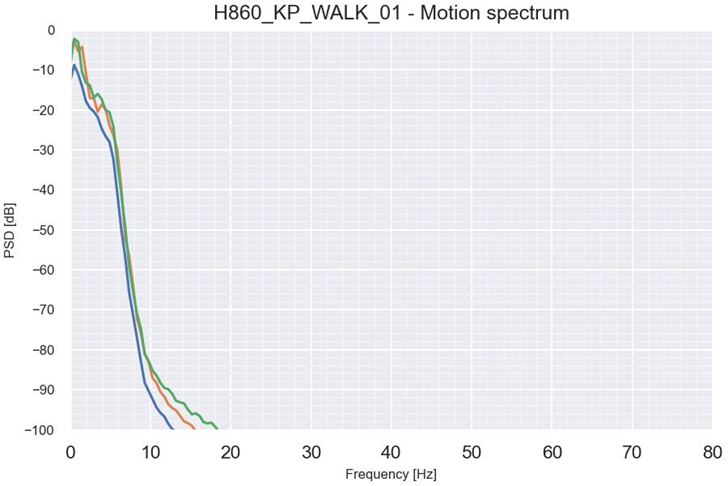
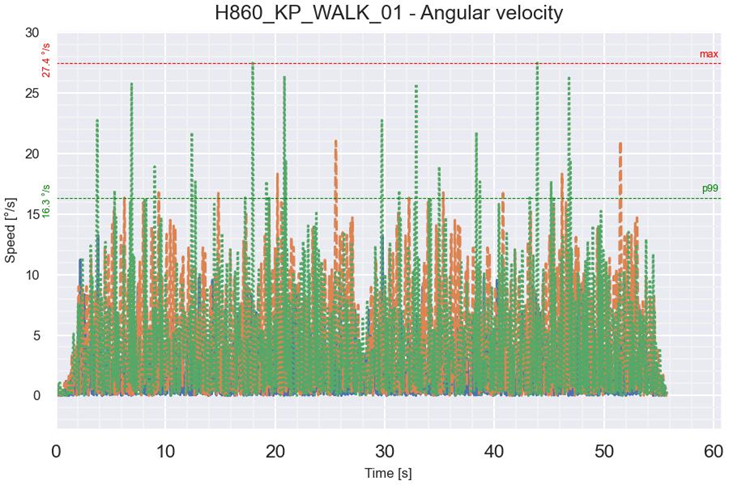
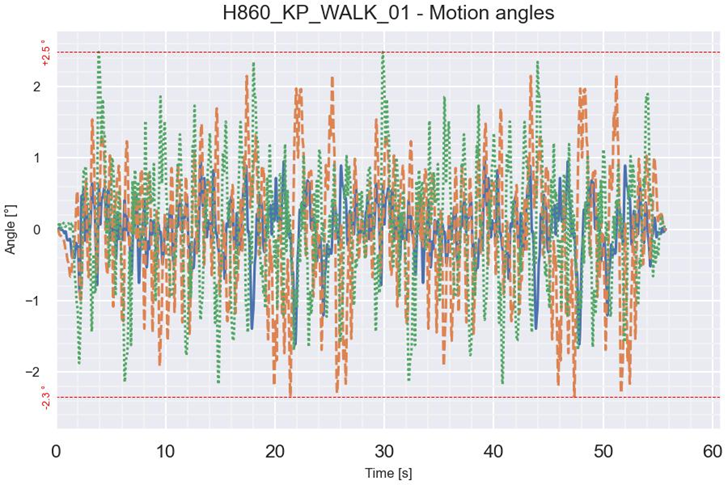
Extract taken from Analyzer user manual, movement characterization graphs for the walking motion, from left to right: motion spectrum, rotation speed, and angular position
Standards-Aware, Improved Metrics
While the CIPA DC-X011 standard defines a methodology for still stabilization based on the longest acceptably sharp exposure, DXOMARK’s approach improves on this by:
- Using modern low-contrast charts aligned with current image quality standards (ISO 12233:2024, IEEE CPIQ 1858) for more realistic blur evaluation
- Implementing MTF-based texture sharpness analysis rather than simple edge contrast metrics
- Extending evaluation to video stabilization, analyzing frame-to-frame motion including translation, rotation, zoom effects, and rolling shutter distortions
This expanded metric suite enables engineers to understand not just blur reduction but how well stabilization systems maintain geometric integrity and temporal smoothness.
Learn more about CIPAPhoto and Video Stabilization Analysis
Photo Stabilization
The methodology reproduces controlled shake profiles while capturing still images. Hundreds of images are acquired with stabilization on and off, allowing DXOMARK to determine the longest exposure that yields acceptable sharpness. This exposure gain metric quantifies the stabilization system’s ability to extend usable exposure times under motion.
Video Stabilization
Video analysis focuses on frame-to-frame motion and deformation. DXOMARK’s workflow captures sequences under controlled motion and computes metrics for translational and rotational motion reduction, as well as compensating for rolling shutter deformation inherent to CMOS sensors. This approach gives comprehensive insight into both smoothness and residual distortion in video.
Learn more about DXOMARK metrics
Photo evaluation graph with DXOMARK Analyzer software
Why They Came to Us
Traditional stabilization tests offer limited insight into real-world use because of constrained motion profiles and outdated metrics. DXOMARK’s solution addresses this by combining:
- High-fidelity motion simulation platforms
- Enhanced metrics that capture both motion reduction and image fidelity
- Repeatability and automation for engineering and QA workflows
Together, these capabilities provide manufacturers and imaging engineers with a powerful toolset to measure, compare, and optimize image stabilization performance across devices and use cases — from handheld mobile capture to video in dynamic motion environments.