
 Camera
  Display
  Battery
  Smartphone
  Security
  DSLR & Mirrorless
  Tv Screens
  Automotive
  Medical
  3D Camera
  Industrial Vision
  Computing
  AR / VR
  Drone & Action camera

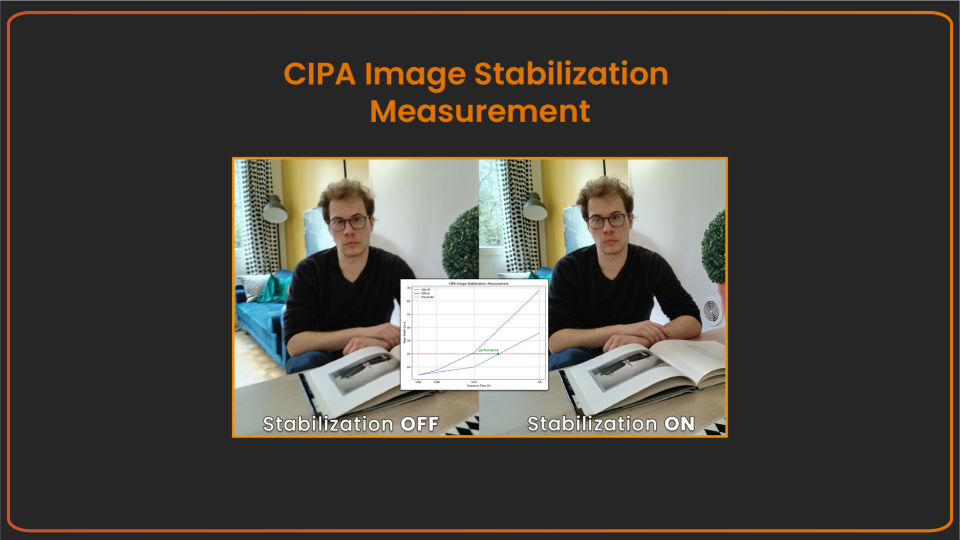
Stab series: How Can We Measure Image Stabilization? (1/3)
Measuring how well a camera system compensates for hand shake is more complex than it looks.
The Camera & Imaging Products Association (CIPA) in Japan has proposed and developed a standard to ensure objective and repeatable testing, the CIPA DC-X011.
The primary purpose of the CIPA DC-X011 specification is to define measurement methods for evaluating image stabilization performance in digital cameras, ensuring consistent and comparable results across manufacturers. The first version of the standard has been adopted as ISO/CD 20954-1, and a new revision is under review to include modern sensor technologies and more realistic motion simulation.
To test stabilization, the camera is mounted on a CIPA-certified vibration simulator that reproduces natural hand shake under controlled lighting. Hundreds of images are captured, with and without stabilization, of an edge target composed of black-and-white tiles and natural texture patterns used to analyze blur. CIPA measures the ratio between the longest exposure times that remain acceptably sharp with and without the stabilization solution under test enabled. This ratio is expressed in Exposure Values (EV), where 1 EV means the ability to shoot with twice the exposure time without a visible blur difference.
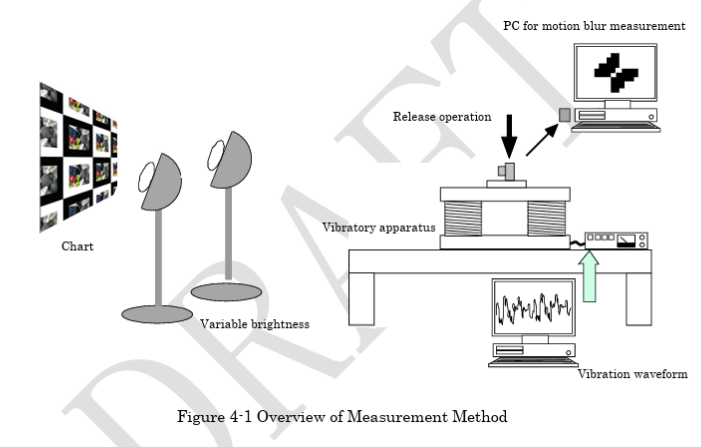
However, as imaging standards have evolved, parts of the original DC-X011 method have become outdated within the industry. The DC-X011 standard is very specific to its test chart, which limits flexibility. It also relies on high-contrast edges, unlike modern standards that favor low-contrast edges for more realistic imaging. Furthermore, its blur estimation method is not aligned with MTF-based approaches (Modulation Transfer Function), which have been the industry standard for decades, and is less robust to noise than the standard ISO 12233 MTF.
At DXOMARK, these measurements are performed on advanced hexapod shaking platforms capable of reproducing various movements, from simple handheld motion to walking or running. Tests use modern low-contrast edge charts (ISO 12233:2024 / IEEE CPIQ 1858 / IEEE 2020) and controlled multispectral lighting systems that simulate real shooting environments with precision from 0.1 to 50,000 lux and across the visible to infrared spectrum.
This evolution ensures that image stabilization testing reflects real-world performance, providing
manufacturers and consumers with transparent and meaningful results.